


Structural retrofits often get discussed in terms of engineering plans and reinforcement strategies, but the physical work that makes those plans possible usually starts with drilling. Whether a building needs seismic reinforcement or foundation stabilization, precise drilling is what allows new structural elements to connect properly with existing construction.
Seiscore is a specialty shoring and structural contractor that self performs drilling, shoring, structural, and concrete work for commercial general contractors. This capability matters significantly for retrofit projects, where drilling into existing structures requires a different level of precision than working with open excavation sites.
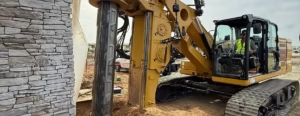
Why Retrofit Drilling Is More Complex Than New Construction
Drilling into an existing building introduces challenges that don’t apply to new construction. Crews need to understand what’s already in place, existing foundations, structural elements, and potential obstructions, before drilling can begin safely and accurately.
- Existing structural elements may limit drilling angles or locations
- Older buildings may have undocumented foundation conditions
- Precision becomes critical when connecting new reinforcement to existing structure
- Site access is often more constrained than on open excavation projects
These added complexities are exactly why retrofit drilling benefits from a contractor with direct structural expertise, rather than treating it as a purely mechanical drilling task disconnected from the broader engineering goals.
Soft Story Retrofits and Seismic Safety
One of the more significant applications of retrofit drilling involves soft story buildings, which are particularly vulnerable to racking during an earthquake. This vulnerability can lead to serious structural damage, potentially making a building unsafe or unlivable after a seismic event.
Soft story retrofits typically involve drilling to install new structural connections or reinforcement elements that strengthen a building’s ability to resist lateral forces. This work requires a careful balance between structural engineering knowledge and precise, hands on drilling execution, since the reinforcement only works as well as its connection to the existing structure.
Foundation Repair and Retrofit Drilling
Beyond seismic retrofits, drilling also plays a central role in foundation repair work. When a building has settled unevenly, causing cracks in walls or the foundation itself, structural crews often need to drill in order to install support elements that stabilize or relevel the affected area.
This kind of work requires understanding both the current condition of the foundation and the surrounding soil, since the drilling approach needs to account for factors like soil composition and existing structural loads.
Why Self Performing Drilling Benefits Retrofit Projects
Retrofit projects tend to involve more uncertainty than new construction, simply because so much depends on the specific condition of an existing structure. A contractor that self performs drilling alongside structural work can adapt in real time when conditions differ from what was expected, without needing to bring in a separate specialist mid project.
This adaptability becomes especially important on commercial buildings, where retrofit work often needs to happen with minimal disruption to ongoing operations inside the structure.
Retaining Walls as Part of a Broader Retrofit Strategy
In some cases, structural retrofits extend beyond the building itself to include retaining wall work, particularly on properties affected by soil movement or hillside pressure. Retaining walls help protect a structure from ongoing earth movement, which can be an important component of a comprehensive retrofit strategy in areas prone to landslides or soil erosion.
Drilling for retaining wall anchors or piles follows many of the same precision requirements as other retrofit drilling work, reinforcing just how central this early phase is across nearly every structural scope.
Verifying Contractor Credentials for Retrofit Work
Because retrofit and structural work directly affects a building’s long term safety, verifying a contractor’s licensing and insurance is an essential step for any commercial GC managing this type of project. Seiscore holds California Contractor License 1126002, along with insurance coverage designed for commercial GC contracts, providing a clear standard of accountability throughout the retrofit process.
Planning Retrofit Projects Around Drilling Complexity
Given the added complexity involved in retrofit drilling, planning ahead with an experienced structural contractor helps avoid delays once work begins. Understanding existing structural conditions before drilling starts allows for a more accurate project timeline and reduces the likelihood of unexpected complications mid project.
Final Thoughts
Structural retrofits, whether focused on seismic safety or foundation stability, depend heavily on precise, well coordinated drilling work. Working with a specialty contractor that self performs drilling alongside structural and concrete scopes provides the technical depth needed to handle the added complexity that comes with reinforcing existing commercial buildings.
FAQ
Why is drilling more complex for retrofit projects than new construction?
Retrofit drilling must account for existing structural elements and potentially undocumented foundation conditions, requiring greater precision than open excavation sites.
What role does drilling play in a soft story retrofit?
Drilling allows new structural connections and reinforcement elements to be installed, strengthening a building’s ability to resist lateral forces during an earthquake.
How does retrofit drilling relate to foundation repair?
Drilling is often needed to install support elements that stabilize or relevel a foundation that has settled unevenly over time.